


Demand Generation vs. Lead Generation
Demand generation vs. lead generation has become one of the most talked-about distinctions in B2B marketing in the last few years.
However, few marketing teams have deal with the implications.
Most B2B companies still run Google Ads, count form fills, and call it a marketing program. Pipeline looks fine...until it doesn't.
Then the question becomes: why did lead flow dry up when nothing changed? The answer is almost always the same. You're doing lead generation without demand generation, and the difference between demand generation vs lead generation is the difference between capturing a market and creating one.
Here's the truth: lead gen only works on buyers who are already looking for you. That's roughly 3–5% of your total addressable market at any given time. The other 95% has never heard of your company. Lead gen doesn't reach them. It can't. And when that small active-buyer pool thins out because of seasonality, market shifts, or simple saturation, your pipeline collapses with no warning.
Demand Generation vs. Lead Generation: What's the Difference?
Lead generation captures existing demand. Someone searches "ehs compliance consulting service" or "digital adoption software" clicks your ad, fills out a form. That's demand capture.
Google Ads, review sites, bottom-funnel content are all lead gen channels. They work. We run them for every client. A B2B Google Ads program we manage for an environmental advisory firm generated $881K in pipeline and $301K in closed-won revenue at a 3.36x ROAS over 15 months. That's lead gen doing exactly what it's supposed to do.
But here's the ceiling: you can only capture demand that already exists.
If your total addressable market has 10,000 potential buyers and 400 of them are actively searching this quarter, your Google Ads campaign is competing for those 400. So is every other vendor in your space. CPCs climb, conversion rates plateau, and you start wondering if paid search "stopped working."
It didn't stop working. You just exhausted the pool of people who already know they need what you sell.
B2B demand generation is different. It creates awareness and intent among buyers who aren't searching yet. They're not in a buying cycle. They don't know your company exists. But they will be in-market eventually — and when they are, you want to be the name they already trust. Demand generation strategies include LinkedIn ABM campaigns, thought leader ads, ungated educational content, and anything that builds familiarity with your ICP before they ever open a search tab.
The mistake most B2B companies make is treating lead gen as the entire strategy and demand gen as "nice to have." It's the opposite. Lead gen has a hard ceiling. Demand gen is what raises it.
How Thought Leadership Drives B2B Demand Generation
Most demand generation advice online is vague. "Build brand awareness" with no specifics. So let's get specific about a demand generation tactic that actually moves pipeline: thought leader ads on LinkedIn.
We ran a B2B LinkedIn Ads ABM campaign for a high-end services company targeting enterprise tech companies. The campaign used the founder's face and voice as the creative. Not polished brand ads, not display banners, not cold InMails. Thought leader ads promoted the founder's expertise directly in the feeds of named decision-makers at target accounts.
The results tell the story. Thought leader ads drove 59% of total conversions on just 30% of the campaign's budget. Cost per conversion was $60, the lowest across all campaign types, including document ads and remarketing.
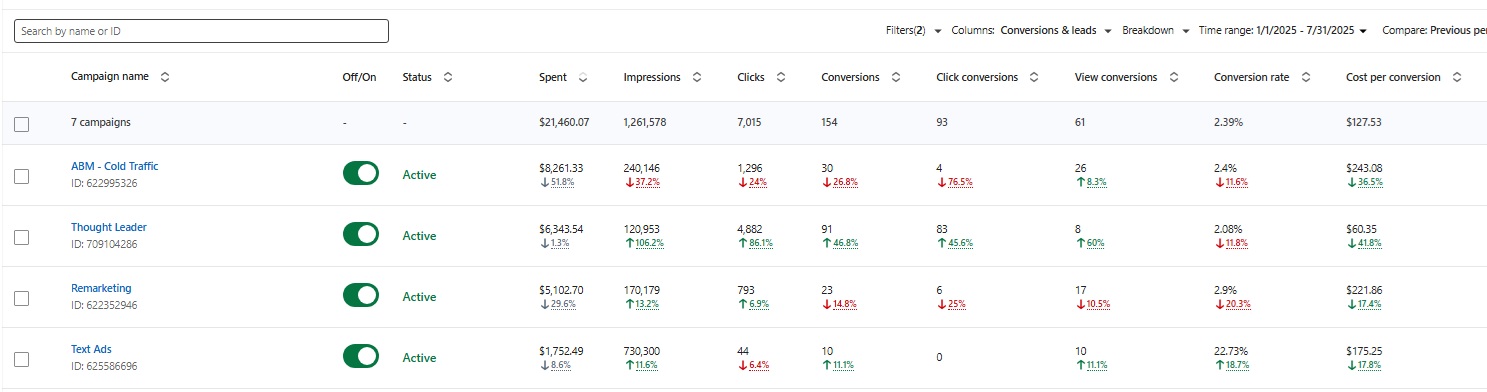
Over seven months, the full LinkedIn ABM program generated $414K in attributed pipeline on $21K in spend, a 19x pipeline-to-spend ratio.
And here's what's worth noting: zero of those conversions came from gated eBooks or lead magnets. Every single one was a direct engagement with the brand. That's what real demand generation looks like. Not buying a list and blasting it. Building trust through consistent, targeted presence until a prospect is ready to engage on their own terms.
The traditional ABM playbook of running display ads through a data vendor doesn't generate demand. It generates impressions that nobody remembers. Thought leadership from a real person, on a platform where your buyers are already spending professional time, is what actually shifts accounts from "never heard of you" to "I've been seeing your stuff everywhere."
What a Full-Funnel Demand Generation Strategy Actually Looks Like
Demand generation and lead generation aren't competing strategies. They compound each other. The real question isn't which one to run. It's what happens when you run both.
Here's the framework: LinkedIn generates demand. Google captures it. LinkedIn ABM puts your founder's thinking in front of named accounts over weeks and months, building familiarity and trust. When those same buyers eventually start searching for a solution, and they will, they're more likely to click your Google Ad, more likely to convert, and more likely to close. The demand creation channel feeds the demand capture channel.
We see this play out directly in client data. That same high-end services company running LinkedIn ABM alongside Google Ads? The LinkedIn program generated $414K in pipeline. Google Ads generated $573K. Combined, that's nearly $1M in total pipeline across both channels, from a company that was previously capped at whatever their outbound team could manually prospect.

The Google Ads pipeline was strong on its own: 58x pipeline-to-spend, 66% sales-qualified lead rate, 16 pipeline opportunities in six months. But that was capturing demand from buyers who were already searching. The LinkedIn layer created pipeline from accounts that were never going to show up in a Google search until someone put the company on their radar.
Now consider what this looks like scaled. Another client in the high-end technology consulting space generated $881K in pipeline from Google Ads alone, capturing demand from a market that was already searching for their services. That's a strong program. But what happens when you layer LinkedIn demand generation on top of a market that large? You're not just capturing the 3–5% who are searching. You're influencing the 95% who aren't, and moving some of them into the search pool months earlier than they would have arrived on their own.
That compounding effect is what separates B2B companies that plateau at a certain pipeline number from companies that break through it. Lead gen alone has a ceiling. Demand gen is what raises it.
Building a program that does both--creating demand among future buyers while capturing intent from current ones--is exactly what our demand gen consulting engagements are designed to solve.
Frequently Asked Questions
What is the difference between demand generation and lead generation?
Lead generation captures buyers who are already searching for a solution, through channels like Google Ads, review sites, and gated content. Demand generation creates awareness and trust among buyers who aren't in-market yet, using channels like LinkedIn ABM, thought leader ads, and ungated educational content. Most B2B companies only invest in lead gen and miss the 95% of their market that isn't actively searching.
What are the most effective B2B demand generation strategies?
The most effective demand generation tactics for B2B companies are thought leader ads on LinkedIn (promoting founder-led content to named accounts), ABM campaigns targeting specific company and contact lists, ungated content that builds expertise and trust, and cross-channel remarketing that maintains presence throughout a long buying cycle. The key is consistent, targeted exposure, not one-off campaigns.
Can you run demand generation and lead generation at the same time?
You should. The two strategies compound each other. LinkedIn demand generation builds familiarity with your brand among target accounts. When those accounts eventually enter a buying cycle and start searching, your Google Ads campaigns capture that intent at a higher conversion rate. Running both channels together produces significantly more total pipeline than either channel alone.