


Google Ads for Law Firms
Running Google Ads for law firms presents unique challenges. CPCs are among the highest of any service category. There are a lot of prospects not able to afford legal services, and just looking for free advice.
Most law firm Google Ads accounts we audit share the same problem: they look like they're working. Conversions are coming in, cost per lead seems reasonable, the agency sends a nice report every month. But when you actually listen to the calls and read the form submissions, it's spam. Google Ads for law firms can absolutely generate real cases — but only if the account is built to filter out the junk that Google is more than happy to send your way.
We took over a probate law firm's Google Ads account that was reporting 8 conversions a month at $69 each. Sounds fine on paper. In reality, nearly every one of those conversions was a spam submission generated by Google's Search Partner Network. The firm was spending $600 a month to acquire nothing.
We proceeded with a full rebuild, cutting 69 of 79 keywords, excluding junk traffic networks, implementing call tracking, and tightening match types.
Cost per qualified lead dropped to $82, lead quality hit 90%+, and the firm scaled spend from $600 to $1,500 per month with confidence that every dollar was driving actual prospective clients.
Here's what we did, and what it means for your firm.
Why Most Law Firm Google Ads Accounts Waste Money
When we run an audit on a law firm's Google Ads account, we almost always find the same set of problems. They're not obscure technical issues. They're structural decisions that Google makes easy to get wrong.
Search Partners and Display Network are turned on. This is the single biggest source of wasted spend we see. Google's Search Partner Network and Display Network placements are on by default, and for lead generation — especially legal — they generate low-quality traffic at best and outright spam at worst. In the probate firm's account, conversions from these networks were more expensive than search conversions and were almost exclusively junk.
The keyword list is bloated. The account had 79 active keywords. When we looked at the data, 69 of them had never generated a single conversion. Most had barely generated clicks. That's not a keyword strategy. It's keyword hoarding. Every irrelevant keyword dilutes budget from the terms that actually drive cases.
Nobody is tracking phone calls. The firm had a phone number prominently displayed on their landing page. People were calling. But none of those calls were being tracked as conversions in Google Ads, which meant the algorithm had no signal on what was actually working. You can't optimize what you can't measure.
Deprecated ad types are still running. The account was running legacy Expanded Text Ads alongside newer Responsive Search Ads. Some of the ETAs were performing, some weren't. But nobody had evaluated which to keep and which to retire. The result was an inconsistent ad experience with no clear testing framework.
These aren't edge cases. If you're running Google Ads for lawyers through a generalist agency or managing it in-house without dedicated PPC experience, there's a good chance your account has at least two of these issues right now.
Why Is PPC Important for Law Firms
Law firms operate in markets where the people who need your services are actively searching for them right now. Someone searching "probate attorney Sacramento" isn't browsing. They need a lawyer, and they're going to hire one of the firms on that first page.
That's what makes PPC for law firms fundamentally different from most marketing channels. You're not interrupting people with a message and hoping they remember you later. You're showing up at the exact moment someone has a legal problem and is looking for help.
A few reasons this matters more for law than other industries.
First, referrals are unreliable at scale. Every managing partner we've spoken to says the same thing: referrals are great, but you can't control the volume. PPC gives you a lever you can actually pull.
Second, geographic targeting is precise. If you only practice in specific counties or states, you're not wasting budget on people outside your jurisdiction.
Third, the economics work. Even in competitive practice areas where CPCs are $15-$20+, the value of a single retained client--a $5,000 retainer, a $50,000 case--makes the math straightforward. The question isn't whether you can afford Google Ads. It's whether you can afford to let competitors capture that search traffic instead.
How to Structure Google Ads Campaigns for a Law Firm
Most accounts go wrong not in the bidding or the ad copy, but in the foundational structure.
Start with exact match, expand from there. When we rebuilt the probate firm's campaigns, we started with exact match keywords only. That means Google can only show your ads when someone types that precise query (or a very close variant). It's the tightest targeting available, and it lets you validate which terms actually convert before you open the aperture.
Once we had conversion data confirming which exact match terms were driving qualified leads, we gradually introduced phrase match to capture longer-tail variations. This is the opposite of how most agencies set up accounts. They start broad, burn through budget, and then try to narrow down. Especially for high-end services, this is not the right approach. Start narrow. Prove what works. Then expand.
Ruthless keyword pruning. We cut 69 of 79 keywords in that probate account. The remaining 10 were the only terms that had ever driven real conversions. That sounds aggressive, but it's just math. Every dollar spent on a keyword that doesn't convert is a dollar not spent on one that does.
The principle is the same regardless of practice area. You don't need 50 keywords. You need the 8 to 12 that match the way real prospective clients actually search for your services.
Build a negative keyword list from day one. This is non-negotiable. We built a negative keyword list of 113 terms for the probate firm, including broad match negatives for free legal services, informational queries (people looking for definitions, not lawyers), unrelated practice areas, and out-of-state searches.

Your negative keyword list should be a living document. We review search terms weekly in the first few months and at least biweekly after that. Every irrelevant search term that triggers your ad is budget walking out the door.
Exclude Search Partners and Display. Turn them off. For lead gen, especially legal, these networks consistently drive low-quality traffic. If you want to run Display ads, run them as a separate retargeting campaign where you control the audience and placements. Don't let Google mix Display traffic into your search campaigns.
Geo-targeting matters. Set your location targeting to "Presence" (people physically in your target area), not Google's default "Presence or interest" (which includes people who have shown interest in your area but may be nowhere near it). For a law firm, you want people who are actually in your jurisdiction.
Tracking Qualified Calls and Cases
Here's a question: do you know how many phone calls your Google Ads generate each month? Not form fills, but phone calls?
Do you know how many of those phone calls were qualified?
For most law firms, calls are the primary conversion action. Prospective clients want to talk to someone. If you're not tracking calls, you're missing the majority of your conversions and flying blind on campaign performance.
We implemented call tracking for the probate firm using CallTrackingMetrics. This does two things.
First, it attributes phone calls to specific campaigns, ad groups, and keyword, so you know exactly which search terms are driving calls.
Second, it records call duration, which is a proxy for lead quality. A 45-second call is probably a wrong number or a tire-kicker. A 6-minute call is someone describing their legal situation to your intake team.
We used call duration data in CallTrackingMetrics to verify that 90%+ of leads were genuine prospective clients. That's the metric that matters. Not cost per click, not impression share, not even cost per conversion in isolation. The question is: how many of these leads are real people with real cases that your firm can take on?
Cost per click tells you how much traffic costs. Cost per conversion tells you how much a form fill or call costs. But cost per qualified lead--a conversion that your intake team confirms is a legitimate prospective client--is the only number that connects your ad spend to actual revenue.
When we started tracking properly, the probate firm's cost per qualified lead initially spiked to $300. That's because we were now only counting real leads, and the volume was low after cutting junk traffic. But through continued keyword optimization, match type refinements, and device-level bid adjustments, we brought CPL down to $82 over the following months. That's roughly what the old (spam-filled) cost per conversion was, except now every lead was a genuine legal inquiry.
What Real Law Firm Google Ads Results Look Like
Here are the before-and-after numbers from the probate firm engagement:
Before: $600/month spend, $69 cost per conversion, nearly 0% lead quality. Seventy-nine active keywords, Search Partners on, Display on, no call tracking. The account looked like it was performing. It wasn't.
After: $1,500/month spend, $82 cost per qualified lead, 90%+ lead quality. Ten high-intent keywords, 113 negatives, exact and phrase match only, call tracking via CallTrackingMetrics, mobile cost per conversion brought in line with desktop through device optimization.
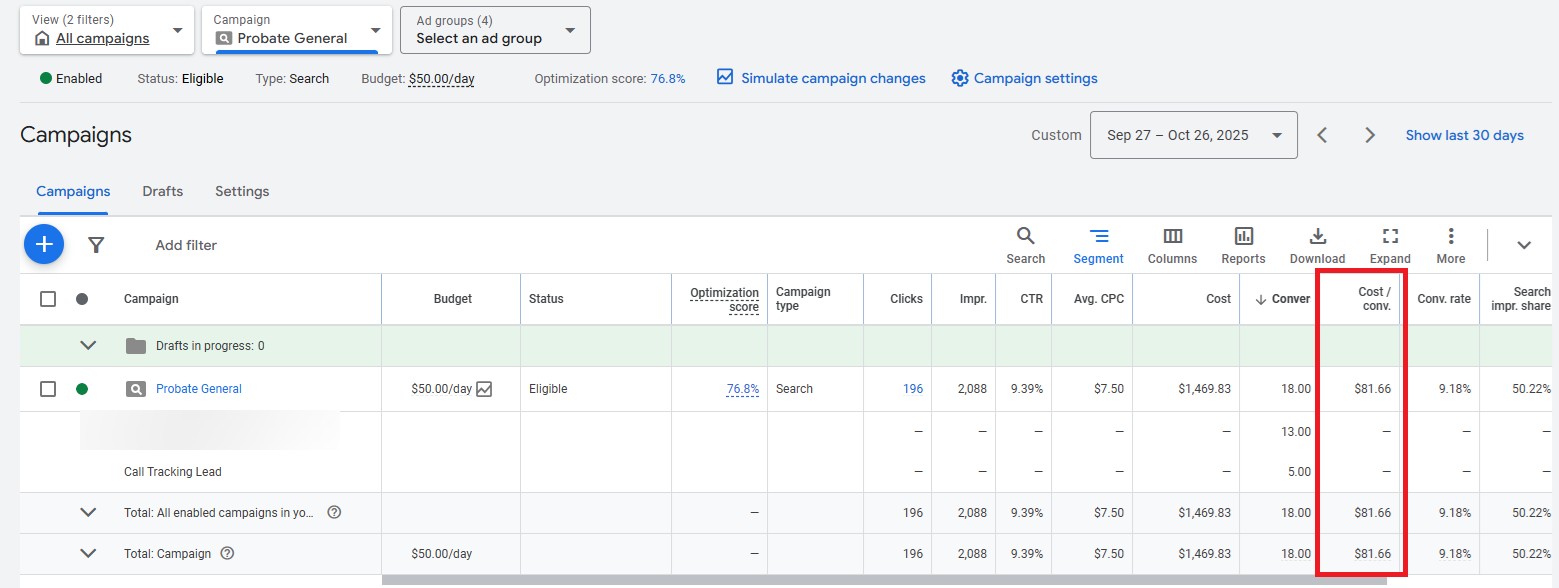
The trajectory matters too. After the overhaul, CPL initially jumped to $300 because we were finally measuring real leads instead of spam. It then dropped steadily as we refined keywords, tightened targeting, and accumulated enough conversion data for the algorithm to optimize against. Getting from $300 to $82 took persistent, methodical work, not a silver bullet.
The firm scaled from $600 to $1,500 per month because the results justified it. When you know that every lead is a real prospective client, scaling budget is a growth decision, not a gamble.
How Much Do Google Ads Cost for Law Firms
The honest answer: it depends on your practice area and market.
CPCs in legal are among the highest in any industry. Personal injury and mass tort keywords can run $50-$100+ per click. Estate planning and probate tend to be lower. We saw roughly $10 per click for the probate firm. Family law, criminal defense, immigration--each practice area has different competitive dynamics.
But CPC alone is misleading. What matters is cost per qualified lead relative to the value of a retained client. The probate firm was getting qualified leads at $82 each. If even one in five of those leads retains the firm at a $5,000 engagement, that's a $410 cost of acquisition on $5,000 in revenue. The math works.
For budget, most law firms can start validating Google Ads performance in the $1,500 to $3,000 per month range. You need enough budget to generate statistically meaningful data: enough clicks and conversions to actually know what's working. Starting at $500/month might feel safer, but you'll likely learn very slowly and make decisions on insufficient data.
One critical note: cheap clicks from Display campaigns are not the same as affordable Google Ads. We've seen firms celebrate $2 CPCs from Display traffic that generates zero qualified leads. A $10 search click that converts to a real case inquiry is infinitely more valuable than a $2 Display click that bounces.
When to Manage In-House vs. Hire an Agency
If you have someone on your team who lives in Google Ads daily, who reviews search terms weekly, manages negative keyword lists, monitors call tracking data, runs ad copy tests, and optimizes bids at the device and location level, you can absolutely run this in-house.
If Google Ads is something someone on your marketing team "also does" alongside everything else, you're probably leaving significant money on the table. The difference between a well-managed law firm Google Ads account and a neglected one isn't subtle. It's the difference between $300 CPLs on spam and $82 CPLs on qualified cases.
If you're evaluating whether your current setup is working, we're happy to take a look. Our PPC for law firms service is built specifically around the methodology described in this guide. Tight keyword targeting, aggressive negative management, proper call tracking, and optimization against qualified leads, not vanity metrics.