


How Online Advertising Works: A Critical Approach
Online advertising works in two ways. Search and shopping ads show up when someone is already looking to buy. Social, display, and video ads reach people who aren't shopping yet, so that your brand comes to mind later, when they are. Most of the effect is slow and pretty hard to see directly in reporting, so if you want airtight reporting to defend this budget, you will need specialized tools.
After fifteen years in the industry, I think about it mostly through the lens of Byron Sharp. Sharp is a marketing professor at the Ehrenberg-Bass Institute in Adelaide, and his book How Brands Grow has a chapter called "How Advertising Really Works."
The book is from 2010, before most of the ad platforms looked anything like they do now, but I still think it explains them better than most of what's been written since.
I don't think Sharp is right about everything. He's also always fighting with someone, so as I discuss the chapter, I’ll also go through some of the main critiques.
What Byron Sharp says about how advertising works
Sharp claims that advertising mostly works by building and refreshing memory structures. It rarely persuades anyone of anything in the rational, argumentative sense. An ad reaches someone who buys products and services in a given category only occasionally. Exposure to your ads slightly raises the odds that your brand gets noticed, or comes to mind, the next time they're buying.
One example he uses is Coca-Cola. Most people buy Coke once or twice a year. Say an ad moves someone's chance of buying a Coke tomorrow from 1 in 300 to 2 in 300. That person might remember the ad, but they likely won’t notice the effect on their purchase behavior. If you ask them, they'll tell you ads don't work on them. Across millions of light buyers, though, that tiny nudge from ad exposure doubles sales among those who saw the ad.
This is part of why advertising so often looks like it isn't working. The effects get spread out over months. Most brands are advertising to hold their share against competitors who are also advertising, so sales stay flat. If you're the one reporting to a CFO, massive ad budgets that lead to flat sales are hard to defend, because explaining that the alternative was declining sales depends on a hypothetical counterfactual. But CFOs of consumer brands that live and die on advertising understand this situation.
Sharp’s recipe is basically to reach all the buyers in the category, avoid going dark for long stretches, get noticed, brand everything clearly, keep refreshing the memories that make the brand easy to recall. He is not against unique sales propositions or arguments—if you have something genuinely persuasive to say, say it, as long as it doesn't get in the way of everything else. But repeating the sales argument is less important than repeating your presence in the product category.
The chapter only mentions online advertising once. Sharp says that "apart from a very small amount of direct-response advertising (including online search engine advertising), advertising must work through memories" (p. 146). I'll come back to that.
Why Sharp thinks differentiation is overrated
Sharp’s view of advertising is consistent with his overall view of how to build a brand. Sharp spills a lot of ink arguing against the differentiation paradigm in branding. For Sharp, differentiation is mostly wrong, or at least wildly overrated. He pins the textbook version on Philip Kotler, where brands target segments, carve out niches, and grow by selling more to their most loyal customers.
The positioning people went even further than Kotler. Al Ries and Jack Trout, authors of Positioning: The Battle for Your Mind and The 22 Immutable Laws of Marketing, told marketers that if you can't be first in a category, you should set up a new one. Trout's "differentiate or die" is a slogan Sharp likes to mock.
Sharp’s evidence is that competing brands sell to almost the same customers, who rarely see their own brand as that different from the alternatives. McDonald's and KFC sell different food and still share customers as if they were interchangeable.
So instead of differentiation, Sharp argues that brands should pursue distinctiveness. Brands need things that make them easy to spot, like colors, logos, characters, and taglines. In his words, it "means less trying to find unique selling propositions and more trying to find unique identifying characteristics" (p. 133).
The goal is to make the brand easier to buy for more people in more situations, which he splits into two ideas. Mental availability is "the propensity for a brand to be noticed and/or thought of in buying situations" (p. 191). Physical availability is "making a brand as easy to notice and buy as possible, for as many consumers as possible, across as wide a range of potential buying situations as possible" (p. 196).
How online advertising works under Sharp's model
Sharp's discussion of advertising focuses mostly on TV, supermarkets, and soft drinks. The model maps onto digital pretty well, though, and I use traditional media analogies when explaining digital advertising channels to clients.
Search and shopping ads are the digital shelf.
Paid search and Google Shopping ads are essentially about physical availability, the digital version of being on the shelf. When people are searching for whatever you sell, you want to show up in their searches and be easy to buy.
A footnote in Sharp's chapter fits B2B surprisingly well. He describes "recency" categories like mortgages, insurance, and cars, where people tune out most ads until they start actively looking and then suddenly become very receptive (p. 139). Most B2B software and services work the same way. Nobody thinks about digital creative production or clean energy consulting until they need it, and then they Google it.
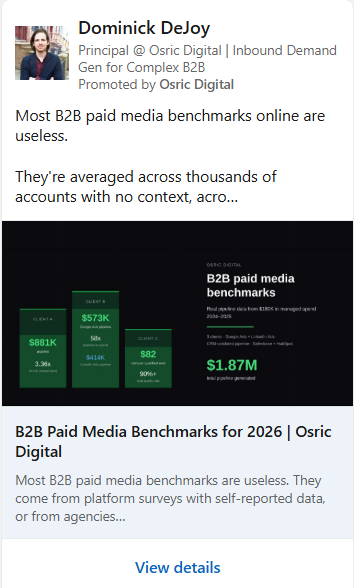
For one Osric Digital client, a digital production studio, Google Ads generated $573K in pipeline in the first half of 2025, a 58x pipeline-to-spend ratio. Those people were already looking, so the job was mostly to be there and not waste money on the wrong searches. (In a new B2B account, a lot of the first month is just adding negative keywords, because Google sends a lot of junk traffic early on.)

Sharp himself would probably push back a bit on the shelf comparison. His definition of physical availability is stricter than "people can find you if they look." He says a website that takes orders 24 hours a day is nowhere near full availability, because he means "readily available." He explicitly sets aside "available if a consumer is motivated to seek out the product" (p. 196). Someone typing a query into Google is exactly that motivated consumer. So search is the closest thing online to a shelf, but it only reaches people who already thought of the category, and often people who already thought of you.
The best evidence I know of on this is from eBay. In a large field experiment, eBay turned off its brand keyword ads and found basically no short-term benefit, since people just clicked the organic link instead. Non-brand ads did bring in new and infrequent buyers, while frequent buyers, who soaked up most of the budget, bought anyway (Blake, Nosko & Tadelis, 2015).
Reading the study through Sharp, I think this means brand search mostly harvests mental availability that was already built by other marketing efforts. Non-brand search is closer to an actual shelf, and it brings in the light, occasional buyers Sharp cares about.
That said, it’s always important for advertisers to bid on their own brand terms anyway, to avoid competitors stealing your brand equity at the last moment. Our clients often push back on this because they think they are bidding on traffic they would get anyway. But eBay’s report drew the wrong conclusion, in my view, at least until Google decides to stop letting advertisers bid on their competitors’ brand terms (fat chance).
Many prospective clients who contact us want to reach people ready to buy immediately and take a very direct response approach. In such cases, we always recommend starting with paid search on Google Ads. The problems, though, are:
With this approach, they reach only a small segment of the market.
If the product is innovative, there may not be much search volume for the category.
In certain highly competitive niches, like fintech, CPCs may be high relative to the maturity of the offer and the sales team’s current efficiency.
Paid social, display and video build memory
Paid social and display build mental availability. So that, when someone enters the buying cycle, your brand comes to mind and makes the shortlist.
In B2B, this is the logic behind the "95:5 rule." John Dawes at Ehrenberg-Bass, working with LinkedIn's B2B Institute, estimated that only around 5% of business buyers are in market for a given product at any given time. Most people who see a LinkedIn ad today will buy months from now, or never. The advertiser’s goal is for the ad to still be in their head when they do enter the buying cycle.
Sharp's rules carry over pretty directly. Reach the whole market continuously, with reasonable frequency, and make it obvious whose ad it is.
An ad people like but can't connect to your company doesn't do much for you. His example is Miller Lite's "Man Law" campaign, which people remembered as the "man law" ads without any idea it was Miller (p. 206). I see a B2B version of this a lot, where the creative is clever, and the logo shows up in the last frame, if at all.
What's worked best for us on LinkedIn is putting a recognizable person front and center. For the same digital production studio, Osric Digital ran Thought Leader Ads with the founder as the face of the campaign, and they drove 59% of conversions on 30% of spend. A familiar face is a pretty good distinctive asset. People and characters are more memorable than logos—which is why campaigns like Tony the Tiger succeed.
One thing Sharp couldn't have seen coming in 2010 is that the platforms work against his advice by default. LinkedIn and Meta optimize for people likely to click or convert, which in practice means heavier, in-market users. If you leave everything on default settings, paid social drifts toward the small group of people who were going to buy anyway. However, you can manage this with reach objectives, frequency caps, and broader audiences.
A good working model, but a folk science
This is a good working model of how advertising works, and I use it all the time. But as a practitioner, I think these are folk-scientific heuristics, and Sharp thinks he's doing positivist science.
Indeed, he has a somewhat antiquated view of science as the pursuit of law-like relationships. He calls his findings "laws," and he calls the statistical model behind most of them, the NBD-Dirichlet, "one of marketing science's greatest achievements" (p. 215). Many people disagree, both practitioners and academics.
The critiques of Sharp
At the practitioner level
Mark Ritson is probably Sharp's best-known sparring partner. At their 2017 debate at the Festival of Marketing, Ritson argued that targeting and mass reach work together ("It's not A against B, it's A and B versus just B"). He later called this "bothism," meaning brands need salience and also a clear, differentiated position. He also said Ehrenberg-Bass "has the habit of overegging its scientific omelettes," which I think is fair.
Nigel Hollis, then at Millward Brown, argued that Sharp underrates innovation because "perceptions of positive differentiation can last for decades" even when the real advantage in product features doesn't. Apple’s iPhone has had no meaningful lead over better Androids for more than ten years, but most people still see the iPhone as the premium smartphone.
James Hier at MEC accepted Sharp's laws and rejected his rules. Distinctive assets work because they mean something, he argued, and the alternative to meaningful differentiation is "meaningless distinction." David Taylor at the brandgym added that penetration isn't the only way to grow, and that ads built only to refresh memories risk turning into "wallpaper."
Les Binet and Peter Field have a different fight with Sharp. Their IPA research recommends roughly a 60/40 split between brand building and activation, and spending above your market share if you want to grow. Sharp has called the 60:40 rule "terrible, very misleading," and tells marketers to spread their budget "across timeslots, across locations." So the two best-known evidence-based camps in marketing—Ehrenberg-Bass and IPA—also don't agree.
For B2B, the bigger issue is just that it's a different kind of market. Sharp's evidence comes mostly from consumer categories with millions of buyers. A B2B software company might have a few thousand accounts in its entire market, with several people involved in each decision. Ehrenberg-Bass has tried to extend the work to B2B (that's where the 95:5 rule comes from), but account-based marketing, which we run a lot of, is targeted by design.
My view is that in B2B the "whole category" is often just a finite list of accounts, so reaching all category buyers and running ABM can end up being the same plan. For the production studio, Osric Digital's LinkedIn ABM program turned about $21K in spend into $414K in pipeline, roughly 19x, by staying in front of every account on the list for seven months. We couldn't have maintained the high frequency that drove performance if we had tried to cover the whole market; we didn't have the ad budget of a huge CPG brand.

At the scholarly level
The most basic objection is whether marketing is governed by laws at all. Sharp models marketing on the natural sciences, and Ritson's response in their debate was, "We don't study rocks, we study people." Even a friendly academic review noted that readers outside the marketing science tradition might feel "some degree of intellectual discomfort" with its positivist laws (Reeves, University of Salford).
The model underneath also has a problem. The NBD-Dirichlet assumes a stationary market (Graham, Scriven & Bennett, 2012), which feels awkward for a book called How Brands Grow. The patterns describe what bigger brands look like, but they don't explain how they got bigger.
Joel Rubinson, a market researcher, adds that the model can't represent close rivals at all. Sharp admits as much when he notes that Diet Coke and Diet Pepsi share more buyers than predicted (p. 191).
Others accept the patterns but question how far they push them. Formisano, Pauwels and Zarantonello (2020) object to treating availability as "the only (costly) response to all marketing challenges." Rob Meyerson points out that Ehrenberg-Bass measured differentiation by asking consumers directly how different or unique a brand is, which is a strange question to ask anyone.
The older debate is between strong and weak theories of advertising. Sharp's chapter is basically the latest version of Andrew Ehrenberg's "weak theory." Ehrenberg's 1974 model focused on awareness, trial, and reinforcement, and he found no evidence that advertising "works by any strong form of persuasion or manipulation." John Philip Jones framed the debate in 1990 as "strong force or weak force" and credited Ehrenberg with the weak view. Jones's own single-source research, though, found that about 30% of ads have big sales effects within seven days, and that an ad with no short-term effect does nothing long-term either. Sharp cites the same kind of single-source data (p. 143) as evidence that ads lift sales among the people who see them, but he argues that those effects are spread thinly over months (pp. 137–142). I don't think both readings can be right.
Then there's the critical tradition, which corresponds more with my intellectual interests. Michael Schudson's Advertising, the Uneasy Persuasion (1984) argued that advertising is less powerful than its critics think and that sales often drive ad budgets more than the other way around. For Schudson, advertising’s real power is cultural (he called it "capitalist realism").
Sharp opens his chapter with Jeremy Bullmore's line that advertising troubles sociologists "because they think it works" and financial directors "because they think it does not" (p. 135). The same argument repeats with online ads. Shoshana Zuboff argues that "ownership of the new means of behavioral modification eclipses ownership of the means of production." Tim Hwang's Subprime Attention Crisis (2020) worries about the opposite, that online attention is overpriced and "increasingly garbage."
Over the past fifteen years, data from the spread of attribution and measurement software has, in my reading, mostly supported Sharp’s view that ad effects are real but hard to see. Lewis and Rao (2015) ran 25 online display experiments worth about $2.8 million and found the ROI estimates so noisy that the median confidence interval was over 100 percentage points wide. Across 15 Facebook experiments, Gordon and colleagues (2019) found that the standard non-experimental methods often got the effect wrong.
My reading of this literature is that advertising works, but not as well as most marketers think. The effects are very hard to see. Even if a channel claims attribution in HubSpot or Pardot, the same buyer likely would have purchased anyway, all else being equal. This reading of the evidence supports Sharp's point, but it also suggests we should be skeptical of anyone (Sharp included) who claims to know exactly which ad campaigns drive which effects.
Where I agree with Sharp
However, I agree with Sharp that most of the job is getting thought of and being easy to buy. Reach and avoiding unnecessary friction in the buying process are a big part of the battle. Good creative makes your brand easier to remember. Differentiation matters much less at the marketing stage, where the goal is to get into the consideration set. I think differentiation becomes more important, at least in B2B, during the sales process, when buyers compare a shortlist and try to understand how the market fits together.
For B2B ad campaigns, that means campaigns should aim to reach the whole ICP, including the 95% of ideal customers who aren't buying this quarter, no matter what ad you put in front of them.
In day-to-day campaign management, that means looking at reach and frequency by account as much as click-through rate and conversion metrics.
It also means removing reasons not to buy. Sharp's seventh rule is "don't give a reason not to buy," and he argues that "reasons not to buy can therefore be much more important (to sales) than reasons to buy" (p. 211). On a B2B website, that might be hidden pricing, a 12-field demo form, a slow landing page, or a "talk to sales" wall in front of a product people want to try. It also means you shouldn't force users to click multiple links to request a quote, start a free trial, or book a demo. In Osric Digital's accounts, a dedicated landing page usually converts two to three times better than sending paid traffic to the homepage.
And it means keeping the creative consistent and clearly branded. In Sharp's words, "each advertising campaign should largely be saying the same thing" (p. 208).
I still wouldn't call any of this science. But if you're trying to decide where the next $10K a month goes, I think it's a better starting point than most of what's out there.
FAQ
How does online advertising work?
Advertisers bid in auctions to show ads on search engines, social platforms, and websites. Broadly, search ads rely on a behavioral trigger—search behavior, usually for commercial or transactional terms. They catch people who are already looking to buy. Social, display, and video ads target users based on audience criteria. The goal is usually not to drive an immediate purchase, especially in B2B or in higher-ticket sales, but instead to build memory structures. By building these memory structures, the advertiser hopes to increase the odds the brand comes to mind later when the user enters the purchase cycle for their product category.
How much does it cost to advertise online?
Most platforms run auctions, so the price depends on how many other advertisers want to reach the same people. Search is usually priced per click. Social or display can be priced per thousand impressions or per engagement. Osric Digital observes that in competitive B2B SaaS and high-end services markets, clicks on competitive keywords can run $50 or more on Google Ads. We also observe that LinkedIn usually costs substantially more per impression than Meta because you're paying for job-title and company targeting. $50 CPMs are normal, and for CPCs, you can generally expect to pay at least $10 per click on LinkedIn.
What are the main types of online advertising?
Search, shopping, social, display, video, native, and retargeting. In Sharp's terms, search and shopping are closest to physical availability. The other forms of digital advertising mostly build mental availability.