


How to Market a SaaS Company with Paid Search
Very few marketers understand how to market a SaaS company with paid search.
Most SaaS marketing advice boils down to "write blog posts and wait." Content marketing, SEO, events, community building are all valid channels, all requiring 6–12 months before you can tell whether they're working. If you're a Series A SaaS company that needs pipeline this quarter, that timeline doesn't work.
Paid search is the fastest path from zero to measurable pipeline for a SaaS company. Not because it's magic, but because it puts your product in front of people who are actively searching for what you sell, right now. However, it only works if you understand what makes SaaS paid search different from standard B2B lead gen.
How Do You Market a SaaS Company?
The honest answer: you market a SaaS company by meeting buyers where they already are in their decision process. The challenge is that SaaS buyers don't behave like e-commerce shoppers. You're selling to buying committees with 3–7 stakeholders, sales cycles that run 30–90+ days, and deal sizes that require real evaluation before anyone signs.
That means most of the popular marketing playbooks--run a bunch of Facebook ads, blast your email list, gate an eBook--underperform because they optimize for volume, not for intent.
Paid search flips this. Instead of interrupting someone and hoping they care, you're capturing people who are already searching for your category. The key is precision. When we built a paid search program for a B2B creative studio, a company with a SaaS-like sales motion and enterprise deal sizes, we launched exclusively on exact match keywords targeting commercial and transactional searches. No broad match. No discovery campaigns. Just people looking to buy.
The result: $573K in pipeline from $9,937 in Google Ads spend across six months. A 58x pipeline-to-spend ratio.

But those numbers didn't happen because we spent aggressively. They happened because we spent precisely, using 814 negative keywords filtering out irrelevant traffic, Salesforce integration tracking pipeline (not form fills), and a 66% sales-qualified lead rate that reflected the quality of traffic hitting the site.
That's how you market a SaaS company. Not by casting a wide net, but by building a system that only catches qualified buyers.
How to Increase SaaS Sales with Paid Media
There are two levers for growing SaaS revenue with paid media, and most companies only pull one.
The first is demand capture, with Google Ads targeting people who are already searching for your product category. These are high-intent keywords with commercial signals. The volume is limited, but the conversion quality is exceptional.
The second is demand generation, which includes tactics such as LinkedIn Ads targeting your ICP who aren't searching yet. Account-based campaigns reaching specific companies and job titles, using thought leader ads, document ads, and remarketing to build familiarity before a buying trigger appears.
The compounding effect of running both simultaneously is the point. That same creative studio ran LinkedIn ABM alongside Google Ads and generated an additional $414K in pipeline at a 19x return. Thought leader ads, with the founder's face and voice in the feed, drove 59% of LinkedIn conversions on just 30% of the budget. None of those LinkedIn conversions came from gated eBooks. Every single one was direct engagement with the brand.
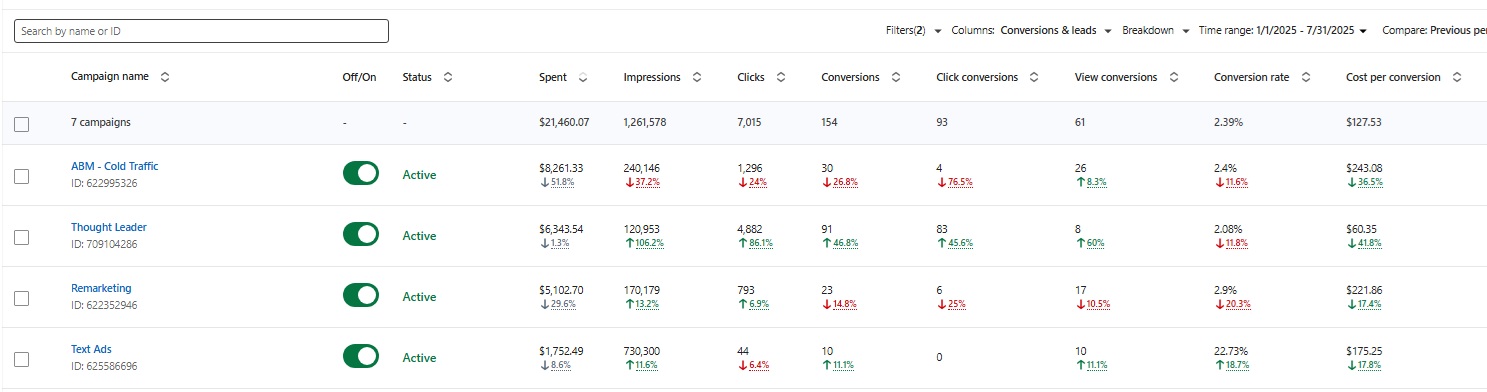
When Google Ads captures the 5% of your market actively searching and LinkedIn Ads warms up the other 95%, you're not just generating leads. You're compressing the sales cycle because prospects already know who you are before they fill out a form. A cleantech advisory firm we work with built $881K in pipeline over 15 months using the same approach, with CRM-integrated paid search as the backbone, with layered paid social expanding the aperture.
What Makes SaaS Paid Search Different from Other B2B?
Three things separate SaaS paid search from broader B2B advertising.
- Limited search volume. Your total addressable keyword universe is small. There might be 50–200 searches per month for your core terms, not thousands. That means you can't compensate for poor targeting by throwing more budget at broad terms. Every click has to count, which is why exact match and aggressive negative keyword management aren't optional. They're the foundation.
- Longer sales cycles require CRM integration. If you're measuring success by form fills or cost per lead, you're flying blind. A $50 form fill that turns into a $100K deal and a $50 form fill from someone who ghosts after one email look identical in Google Ads. You need your CRM (Salesforce, HubSpot, whatever you're running) piped directly into your ad platform so you can optimize for pipeline and closed-won revenue, not vanity metrics. Without this, you'll never know which keywords, ads, and landing pages actually drive business, or whether the real problem is upstream of paid search entirely.
- Competitors are bidding on your brand. In SaaS, brand term defense isn't optional. Your competitors are running ads on your company name, and if you're not bidding on your own brand terms, you're handing qualified traffic to someone else. Budget a portion of spend for brand defense. It's cheap, it converts well, and it protects revenue you've already earned through other channels.
If you're evaluating whether paid search belongs in your SaaS marketing stack, the short answer is yes...but only if you build it around pipeline metrics, not lead volume. This is particularly true in highly competitive niches like fintech and HR tech. You can click here to learn more about how we approach Google Ads for SaaS companies: