


Is Advertising Propaganda?
"Many forms of advertising are obviously cases of propaganda," writes the philosopher Jason Stanley in How Propaganda Works (2015).
Propaganda, Stanley argues, is damaging for democracy. So one might conclude, if we accept Stanley's argument, that advertising is also harmful to democracy.
But is advertising actually propaganda?
Many cases of advertising take the form of propaganda as Stanley defines it. But his definition does not apply to all advertising. Whether an ad counts as propaganda depends on how it works.
Stanley defines propaganda as a message that presents itself as embodying an ideal, such as health, liberty or objectivity, while advancing that ideal by nonrational means.
This is already somewhat problematic, at least for rationalists. Such appeals to emotion are attempts at manipulation that treat human beings as means rather than ends.
But propaganda can be corrosive to democracy, Stanley argues, when it works against the ideal it invokes. In such cases, propaganda erodes democratic ideals like liberty and equality while invoking their name. He calls this undermining propaganda. More on that below.
Stanley on advertising
If advertising is a subset of propaganda, then it too can be corrosive to democracy.
Stanley's own example is an ad that uses images of healthy rock climbers to sell an unhealthy drink. It enlists the ideal of health to sell a product that undermines it.
Ads like this fall squarely within Stanley's definition of propaganda. More generally, an ad is propaganda on his account when it borrows an ideal and then either works against it or advances it by emotional or other nonrational means.
Much advertising works differently, though. Ads built on memory and attention, like a repeated logo or a jingle, borrow no ideal at all and fall outside Stanley's definition of propaganda. Therefore, we need to be careful before framing advertising as just a subset of propaganda, although of course in almost all cases it does aim to influence behavior, often through non-rational means.
What Stanley says about advertising
It's important to note that Stanley's treatment of advertising is minimal. He gives it about a page.
The rock climber ad example is enlisted as a straightforward instance of propaganda.
But he sets aside a second class of ads. These attach a product to an ideal it has no bearing on, like a car that promises to make its driver more attractive.
Stanley gives this class its own name, advertising, and defines it as serving "a goal that is irrelevant to those very ideals." Such ads work, he says, by exploiting beliefs that connect "material possessions to aesthetic worth."
This is not propaganda for Stanley because the message and the ideal are entirely unrelated. The car ad may be manipulative, even humbug, but selling a car neither advances nor erodes the ideal of attractiveness; it only borrows that ideal's appeal. Propaganda, by contrast, has to act on the ideal it invokes, either eroding it from within or shoring up a flawed version of it. Mere advertising leaves the ideal untouched, so it is irrelevant to it rather than undermining.
Therefore, the advertising industry produces two kinds of ads for Stanley: propaganda and mere advertising.
Why Stanley thinks propaganda damages democracy
Stanley defines propaganda by its relationship to an ideal. Health, liberty, equality and objectivity are all ideals in his sense. Supporting propaganda advances the ideal it invokes by emotional or other nonrational means, like a stark "cigarettes kill" warning on a pack.
Undermining propaganda is the dangerous kind. It is "presented as an embodiment of certain ideals, yet is of a kind that tends to erode those very ideals."
Stanley's first example of undermining propaganda is the "drug war" of the 1980s and 1990s. Politicians persuaded voters that punishing crack cocaine, the cheaper form of the drug used by poor Black Americans, a hundred times more harshly than the purer powder favored by wealthy whites was a matter of law and order.
The message invoked the ideal of justice, but its goal was a plainly unjust sentencing regime that eroded that very ideal. What kept many citizens from seeing the contradiction, Stanley argues, was a racist belief about how Black people react to drugs. This belief was widely circulated in the twentieth century--a doctor had stated it openly in the New York Times in 1914. It operated tacitly during the drug war to motivate harsh policing and draconian sentencing.
A related belief was captured by the term “super-predator,” introduced in 1995 by the Princeton political scientist John DiIulio. DiIulio described a super-predator as a juvenile “so impulsive, so remorseless” that he could “kill, rape, maim, without giving it a second thought,” and wrote that as many as half of them “could be young, black males.” Hillary Clinton used the term in a 1996 campaign speech. Twenty years later, the Trump campaign circulated that clip to in an effort to suppress Black voter turnout in the 2016 election.
Stanley's larger argument is that substantial social inequality breeds flawed ideologies, or beliefs tied to group identity that are resistant to contradictory evidence.
Privileged groups will cite ideals to justify their status and propagate them. These groups are invested in defending their privilege, and also often control the media and educational systems. They are therefore incentivized to and capable of framing debates in ways that suppress evidence that undermine their privilege.
These beliefs tied to the group identities of privileged groups enable undermining propaganda to work, because they hide the gap between the ideal a message invokes and the goal it serves. Stanley’s illustration is a slaveholding family in the antebellum South. To accept that slavery is unjust, they would have to see their parents as wrongdoers and give up their way of life. So they come to believe that Black people are lazy and need slavery to instill a work ethic. That belief lets a defense of slavery present itself as good for society and good for the enslaved, without the family ever seeing the contradiction.
For the kind of democracy envisioned by Stanley, the damage is concrete. Citizens are supposed to deliberate reasonably with one another to arrive at decisions. Propaganda erodes the empathy that reasonable deliberation depends on.
His account adds two features that might surprise some readers.
First, propaganda can be true. A politician who says "There are Muslims among us" states a fact and still sows fear by appealing to the audience's incorrect beliefs. The statement is literally accurate, but it lands only because listeners already believe Muslims are dangerous, so a true sentence ends up carrying a false message.
Second, propaganda can be sincere. Flawed beliefs can keep the speaker, too, from seeing that the message works against the ideal it invokes .
Stanley also claims that propaganda in democracies differs from propaganda in authoritarian societies. Many people in authoritarian societies are highly skeptical of such communications because everyone--including supporters of the regime--sees the propaganda for what it is.
In democracies, Stanley argues, propaganda is actually more damaging, because people in democracies often don't recognize these messages as propaganda.
These definitions explain why the car ad is a puzzle. The goal is to sell cars; the ideal in Stanley's terms, physical attractiveness, has nothing to do with reasons why you should or shouldn't buy that car.
An ad whose goal is irrelevant to the ideal it borrows neither advances that ideal nor erodes it. I wonder if that's really the case; by associating ideals with irrelevant goals, surely the ideal gets cheapened over time. But by Stanley's own definitions, it sits outside propaganda.
But is advertising actually propaganda?
Stanley's verdict about what kinds of advertising are propaganda rests on two invented ads he makes up and uses as ideal types.
Answering the question properly would require accounting for how advertising actually works.
This is a challenge, however, because neither theorists nor practitioners have never agreed on how advertising works.
Paul Feldwick, who spent decades as an agency planner, catalogs these competing explanations in The Anatomy of Humbug (2015), published the same year as Stanley's account of propaganda.
Feldwick's six lenses
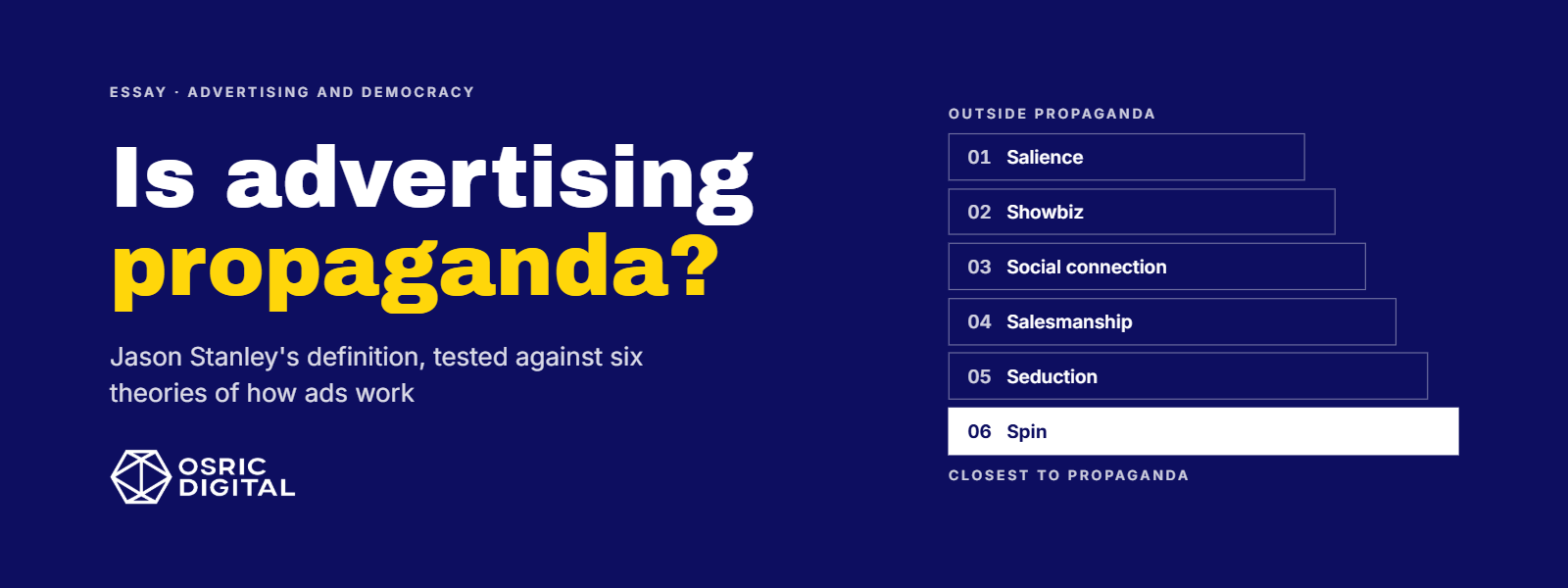
Feldwick reviews six common explanations for how advertising works, while refusing to fully endorse a single one.
In defense of this approach, he borrows the parable of the blind men and the elephant, where each man touches one part and mistakes it for the whole animal. "Every ad," he writes, "is potentially at least an entire elephant."
Many of these explanations lack the criteria for being scientific theories but are instead folk-scientific accounts common among practitioners. Therefore, rather than theories of advertising, I will refer to them as lenses.
Salesmanship. Advertising as rational persuasion. Advertisers seek to win attention, deliver a message and make it believable and memorable. The genealogy of this account runs from John E. Kennedy's characterization of advertising as "salesmanship in print" to Rosser Reeves's "Unique Selling Proposition." Direct-response copywriter John Carlton, make the rather absurd claim that this approach to advertising dates back to prehistory. Feldwick credits this approach's respect for following the data, especially when it is applied in direct response. However, he notes its core assumptions rest on assertion with no evidence behind them. The fact that such advertisers often run A/B tests does not validate these assumptions.
Seduction. Advertising appeals to emotion, association and the subconscious. Feldwick considers the psychology behind it well founded, although exaggerated in books like The Hidden Persuaders. His objection is practical. This approach can explain after the fact why ads worked. However, it offers little help in making new ones, because it fails to predict which ads will successfully seduce audiences.
Salience. Advertising as "mere publicity" that keeps a brand easy to recall. This is the view of the Ehrenberg-Bass Institute. Byron Sharp, its most vocal spokesperson, argues that ads build "meaningless distinctiveness" within a product category. Therefore, if a product has distribution--physical availability, e.g., being stocked ubiquitously in retail stores--then advertising will increase that product's mental availability within a category, and a buyer will have a higher propensity to have that product in mind when they enter the purchase cycle. Feldwick thinks this approach explains a great deal and is badly underrated by practitioners. However, he maintains that it's too simple to be the whole story.
Social connection. Feldwick draws on the communication theorist Paul Watzlawick, who held that every message carries a relationship along with its content. Tone and gesture shape that relationship, and they resist being put into words. Feldwick finds this lens often the most useful in practice. On this view, advertising should create a relationship between prospect and brand. This will create loyalty that will transcend the mechanics of physical and mental availability and create a kind of moat for the business via the brand. This is not a physical moat via weaponized chokepoints, but a brand moat, like that enjoyed by Wrigley's Chewing Gum or Apple.
Spin. Advertising as a way of shaping a shared reality. This is the method of the public relations pioneer Edward Bernays. This is about creating news and buzz, and shaping how the media and the public frame events and decisions. Feldwick sees it at work almost everywhere. He also notes its dark side. Bernays titled one of his books Propaganda; Bernays notes that and Joseph Goebbels admired it.
Showbiz. Advertising as showmanship in the tradition of P. T. Barnum, who called his craft "humbug." Barnum's humbug draws a crowd with spectacle and then gives people their money's worth. A humbug, Barnum insisted, "is not a swindler or an impostor." Rather, the pitch and the spectacle are part of what the audience pays for. That may be, but one can also call much of what went on at the traveling medicine shows of the nineteenth century essentially fraud. Nonetheless, entertainment has become a major part of advertising, especially since the creative revolution.
Feldwick insists the six are not rival theories. In his epilogue, humbug remains one option among the six, "by no means least."
Still, given the book's title, he clearly favors it. He admits he was "happily seduced" by Barnum, and argues that Hopkins, Bernays, Reeves, Ogilvy and Bernbach all built their success "on a solid foundation of humbug," whatever they claimed in public.
On the question of whether advertising is an art or a science, he offers a third answer. Its strongest claim, he suggests, "is to be humbug." His own approach combines showbiz with salience. The point of involving an element of showbiz is to increase mental availability as efficiently as possible. He argues this is usually much more efficient--and much less annoying--than repeating the same USP relentlessly.
By Feldwick's account, the theories themselves were often humbug. He calls Dichter, Reeves, Bernbach and Ogilvy "talented humbugs, both on behalf of their clients and on behalf of themselves," and notes that what Hopkins and Reeves wrote doesn't match what they actually did.
Indeed, some of these advertising legends' promotional materials are a form of propaganda. Hopkins's book Scientific Advertising borrows the ideal of science¹ to sell an agency's way of working, a move close to the borrowed-ideal pattern Stanley describes.
Applying Stanley's test
In order to apply Stanley's test to different forms of advertising, we need to first ask, "Does the ad present the product or service as embodying an ideal?"
If not, it isn't propaganda on his account. If it does, the next question is whether the goal of the ad serves that ideal or erodes it.
Salience and showbiz pass cleanly and are not propaganda, except when combined with either approaches. A repeated logo, a jingle or a truck stunt claims no ideal at all. These ads build memory or put on a show.
They might be manipulative and agenda-driven forms of communication, but Stanley's framework requires the mobilization of an ideal. Without that, it has nothing to grab onto.
Whether approaches drawing on salesmanship and seduction are propaganda depend on how they are executed.
An ad following the salesmanship model that gives real reasons to pick the promoted product engages the audience's judgment. This is not necessarily propaganda. However, the evidence is often cherry-picked, while opposing views are ignored or marginalized.
An additional risk comes in via appeals to authority, which Stanley treats at length. Claims of expertise invite people to defer their own judgment (pp. 40, 51). Advertising drawing on salesmanship frequently invoke authority. This occurs through celebrity or expert testimonials, or, in the case of B2B, famous brands as clients.
Feldwick points out although Reeves often claimed his work succeeded based on argument alone, Reeves's painkiller ads leaned on a man in a white coat, an obvious appeal to authority cue. Appeals to authority are not necessarily invalid--we all rely on experts to make judgments on areas outside our competence. But in the case of Reeves, the man in the white coat was not a doctor, so the ad has more in common with the Milgram experiment than with disinterested argumentation.
The seduction approach to advertising is close to Stanley's characterization. Seduction advertising attaches ideals to the product by design.
When the ideal has no bearing on the product, the ad lands in Stanley's separate advertising category. When the product works against the ideal, as with the rock climbers and the unhealthy drink, it crosses into undermining propaganda.
Spin is where Stanley's concern applies in full. Feldwick's clearest example of this is Light's Golden Jubilee in 1929, a worldwide celebration of the fiftieth anniversary of Edison's light bulb.
It looked like a spontaneous public tribute; even President Hoover in attendance. In fact, Bernays orchestrated the vent for General Electric, as part of a wider effort to recast big business as a benefactor of humanity.
This event fits Stanley's definition of propaganda closely.
The Jubilee presented itself as an embodiment of a civic ideal, a public freely honoring a shared achievement. However, its goal was to manufacture that public sentiment for a corporate client. This creates a public environment where such manufactured spectacles erode the very ideal on display.
Stanley would likely think that manufactured spectacles like the Jubilee are damaging to democracy for two reasons.
First, democracy depends on citizens forming views about power, including corporate power, through open and reasonable debate. This debate becomes more difficult if corporations are manufacturing spectacles to dominate the news cycle, especially if they involve astro-turfed displays of adoration for their founder-CEO.
Stunts like the Jubilee, whose sources are hidden, can't be debated openly, since almost nobody knows it is a message at all. And Stanley argues that unrecognized propaganda does the most damage .
Second, such spectacles spread the false beliefs about privileged social groups that Stanley is especially worried about. The Jubilee promoted elite's flattering story about itself, big business as benefactor. The manufactured event dominates the news cycle to promote this false belief to the public as common sense.
The proliferation of such events creates a climate of widespread cynicism, much like, in more recent years, the decline of journalistic standards driven by clickbait news, which has fed "fake news" and post-truth politics.
What this means for advertisers
For most working advertisers, the answer to the question, "Is advertising propaganda?" is mostly no. Building memory and earning attention don't require borrowing or exploiting anyone's ideals.
Advertising risks becoming propaganda if advertisers are undiscerning about the claims they attach to brands.
B2B creative leans heavily on ideals like being data-driven, efficient or built for growth. However, claims about the potential business impact of new software and AI products are often highly speculative.
Stanley's test would be, "Does the product actually serve the ideal the ad invokes?"
Often, the answer is murky.
For instance, many MarTech and analytics products claim to offer scientific precision but have serious attribution gaps.
The risk is compounded by the fact that, particularly in B2B, clients want to run benefit-driven copy. They generally do not want agencies to run ads that hedge claims.
Particularly in B2B tech, where regulations are sparse and the Silicon Valley libertarian ideology is hegemonic, marketing and sales executives operate more with the caveat emptor approach. In this worldview, over time, the marketplace and reputation will clarify who is lying and whose claims have accuracy.
However, I wonder how accurate this worldview is.
First, it depends on the assumption that the marketplace is efficient. In an environment increasingly dominated by tech platform oligopolies that dominate not just our attention but our political system, that assumption is questionable.
Second, even if it were true that the dust will settle on the best products on a long enough time scale, such an marketing approach tends to pollute public discourse. This is especially true as the line between advertising and editorial and organic content becomes increasingly blurred.
The caveat emptor approach was not the dominant ethos forty years ago. Only since the 1980s has it become common sense that market competition, rather than institutions, will protect public discourse. This historical process is examined in great depth in Network Propaganda (Faris, Roberts & Benkler, 2018), which I will engage with in a future article.
Notes
¹ This is not unique to advertising agencies. Meditation teachers, economic forecasters and life coaches, among many others, appeal to "scientific" authority.