


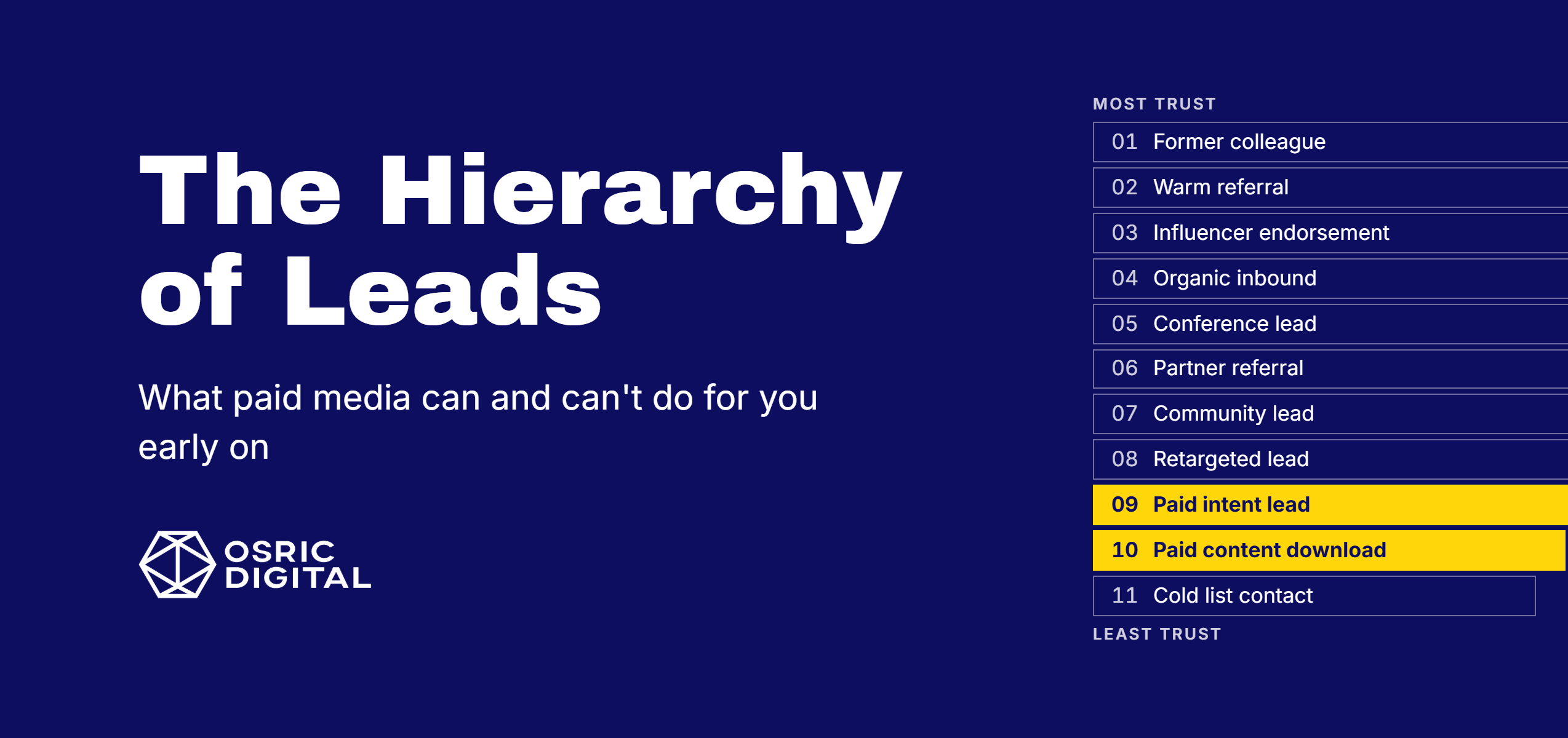
The Hierarchy of Leads: Where Paid Media Leads Fit in B2B
SaaS and high-end services companies that have built traction through founder sales, conferences, and networking and want to begin advertising often assume that leads generated from paid media will behave the same way as leads from their network. The truth is that paid media leads sit near the bottom of the lead hierarchy.
The advantage of paid media is that it's highly scalable. You can generate far more leads with advertising than a founder or sales team could generally reach out to manually while being effective.
But a former colleague or a warm referral arrives already trusting you. A prospect who clicked a Google Ad found you alongside three competitors and knows nothing about you yet. If you're starting paid media for lead gen, plan your budget and your sales process around that gap.
Where most companies are when they start paid media
Most SaaS and high-end services companies that come to us already generate leads through the founder's network, conferences, and organic content. They want paid media to scale what's already working.
By that point, the founders have usually validated the offer by talking to prospects and adjusting it based on what they heard. They've also worked out early messaging and proven it can close deals.
That information is expensive to get through paid media. You can test offers with ads, but in competitive B2B categories, where clicks cost anywhere from $5 to $100 and up, each failed test costs real money. "Do things that don't scale" applies here. Validate cheaply first.
A validated offer still needs creative testing
Even with a proven offer and messaging, expect lots of creative testing. Copy that works in a founder-led sales call or an organic LinkedIn post often needs reworking for cold paid traffic. The audience knows less about you, they see your ad in between everything else in their feed, and the conversion math changes when every click has a cost.
Build that testing into your timeline and budget. When campaigns get killed prematurely by senior leadership, it's usually because nobody set expectations at the start.
The hierarchy of leads
Roughly ordered from most trust to least:
- A former business associate or colleague who has worked with you before
- A warm referral from a trusted mutual connection
- An endorsement from a celebrity or influencer the prospect already trusts
- Organic inbound from someone who has consumed a lot of your content over time
- A conference lead where you spoke at length and are now following up
- A partner or channel referral from an agency, consultant, or platform that recommends you
- A community lead from a peer group, Slack community, or industry association where your name keeps coming up
- A retargeted lead who saw your brand and content repeatedly across channels before converting
- A paid lead from an intent-based channel, such as Google Ads, review sites, marketplaces, or product information downloads
- A paid lead from an information request, such as a thought leadership download
- A cold contact from a list segmented by job title and industry
As you move down the list, the prospect knows less about you and you've earned less trust before the first conversation.
Paid media can move people up the hierarchy
A prospect's position isn't fixed. Someone who sees your founder's posts in their feed for six weeks, reads a case study, and then converts on a retargeted demo offer is a much warmer lead than a cold click. Paid media can build some of the familiarity that used to come only from networks and conferences.
That's why we treat impressions and reach as real metrics. In a LinkedIn ABM program we ran for a B2B podcast production studio, thought leader ads (sponsored posts from the founder's own profile) drove 59% of conversions on 30% of spend. The program generated $414K in pipeline at 19x pipeline-to-spend. Prospects converted after repeated exposure to the founder's thinking, and they showed up to sales calls already familiar with how the company worked.
Some of your budget should capture demand that exists today through Google Ads and other intent channels. Some of it should build familiarity so next quarter's leads arrive warmer.
Why we require a paid discovery process
In initial conversations, I walk founders through this hierarchy, and they almost always agree with it in principle. The challenge is sticking to it once they're spending money on ads and our retainer and not seeing the leads perform the same way their founder sales leads did.
This problem has recurred so many times that we no longer take on startups as retainer clients unless they go through a discovery process first, where we document what has been validated and what still needs testing. This avoids the worst of all possible worlds, where the client expects immediate results from an ad campaign in the first month or two with an offer that's only been tested through founder sales, panics, and pulls the plug prematurely having wasted thousands of dollars without even learning anything.
Prep your sales team
If the founders aren't running sales themselves, the salespeople need the same briefing. A paid lead found you through a search or an ad, so they probably found your competitors the same way and are comparing vendors. This is a much more competitive sale because they have no history with the founder.
They also haven't spent time with your content, so their attention is thinner and the first call has to earn the second.
A rep who expects leads from paid media to behave like warm referrals will conclude the leads are bad and start disparaging the channel. But this is because they are operating with the wrong expectations. While paid media leads are much more qualified than a cold call list, they are generally less qualified than conference or referrals, so they need to be treated more like the first than the second category. Reps who follow up quickly and put proof in front of the prospect early get much more out of the same leads.